How AI Is Changing Dental Marketing
By PMAX Dental Marketing ·
On this page
- 1. Why AI Dental Marketing Matters Now
- 2. AI Is Changing How Patients Search
- 3. AI Is Changing Dental SEO
- 4. AI Is Changing Local SEO for Dentists
- 5. AI Is Changing Google Ads for Dentists
- 6. AI Is Changing Dental Content Marketing
- 7. AI Is Changing Reputation Management
- 8. AI Is Changing Dental Websites
- 9. AI Is Changing Lead Tracking and Reporting
- 10. AI Is Changing How Dental Practices Compete
- 11. What PMAX Dental Marketing Recommends
- 12. How PMAX Dental Marketing Uses an AI Edge
- 13. FAQ: How AI Is Changing Dental Marketing
- 14. The Bottom Line
- 15. Ready to Put an AI Edge Behind Your Practice?
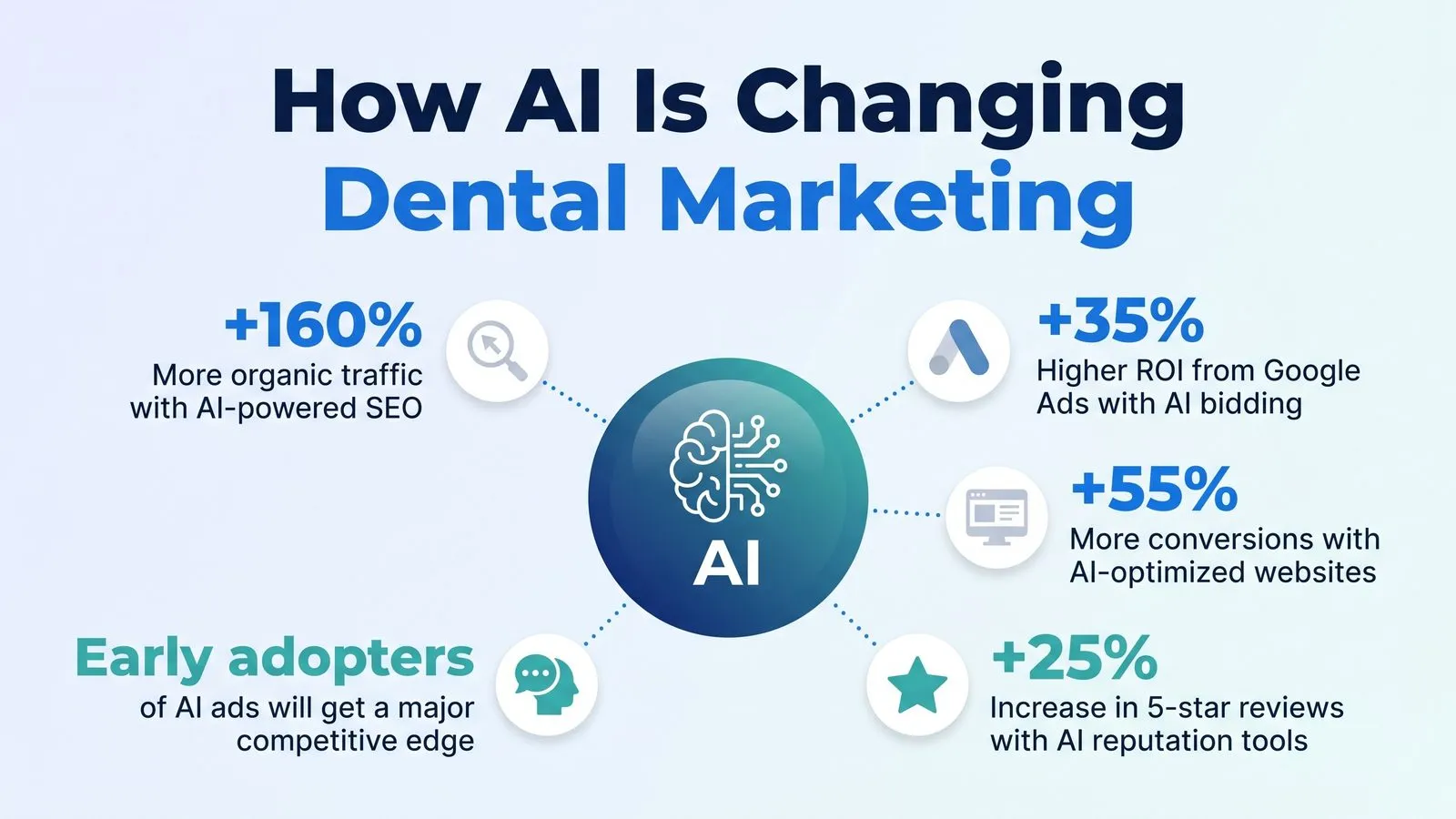
AI is changing how dental practices attract patients, optimize SEO, manage Google Ads, create content, analyze reviews, and track growth. Here’s the complete guide to using AI as an edge — without losing strategy, compliance, or trust.
AI is not replacing dental marketing. It is changing how dental marketing works.
For years, dental practices have relied on the same core channels — Google Ads, dental SEO, Google Business Profile, reviews, websites, social media, referrals, and patient follow-up. Those channels still matter. In fact, AI makes them more important.
The difference is speed, intelligence, and patient intent. AI can analyze search behavior faster, identify content gaps, organize keywords into patient-intent clusters, support ad testing, summarize call themes, and reveal patterns a busy practice owner or marketing team might miss. But AI is not a magic button. Practices still need strategy, compliance, clinical accuracy, trust, local visibility, strong reviews, and a system that turns attention into booked appointments. At PMAX Dental Marketing, we believe the future of dental marketing belongs to practices that combine proven fundamentals with an AI edge.
- 58.5% of U.S. adults research health info online (CDC)
- 45% of the U.S. had a dental visit in the past year (ADA)
- $45B+ in lost U.S. productivity from untreated dental disease
- 80% of consumers search local businesses weekly (BrightLocal)
Why AI Dental Marketing Matters Now
Patients already research healthcare decisions online before they call a provider. The CDC’s National Center for Health Statistics reported that 58.5% of U.S. adults used the internet to look for health or medical information during July through December 2022.
Oral health demand remains significant. The CDC reports that untreated dental disease contributes to more than $45 billion in lost U.S. productivity each year, and unplanned emergency dental care leads to an average of 34 million lost school hours annually.
Dental utilization also leaves room for growth. The American Dental Association Health Policy Institute reports that in 2022, 45% of the U.S. population had a dental visit in the past 12 months, and for working-age adults ages 19 to 64 that number was 40%. Patient need is high, online research is common, and competition for attention is intense — and AI changes how practices compete for that attention.
AI Is Changing How Patients Search
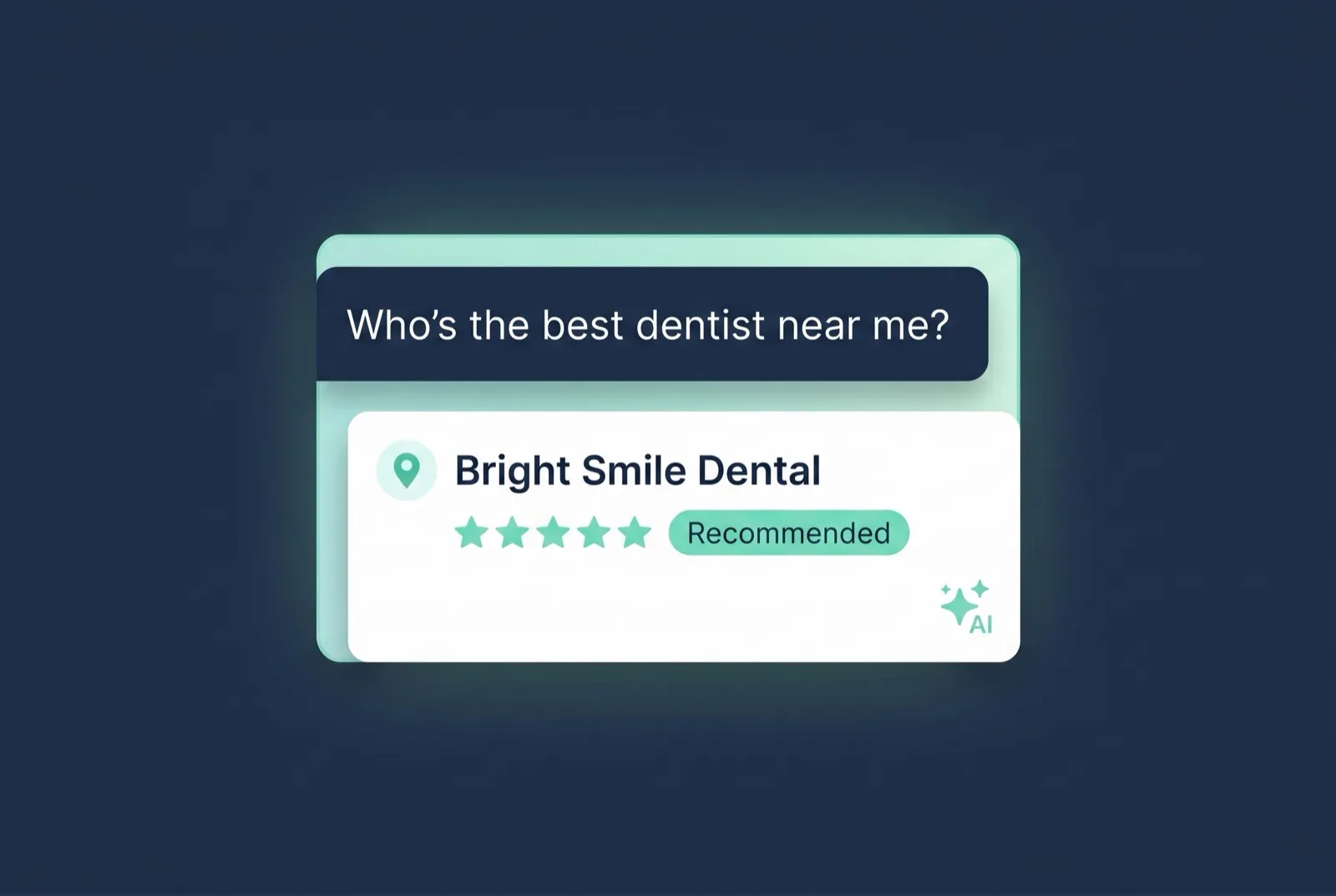
Traditional dental search is keyword-based — “dentist near me,” “emergency dentist [city],” “Invisalign dentist near me,” “dental implants [city],” “cosmetic dentist [city].”
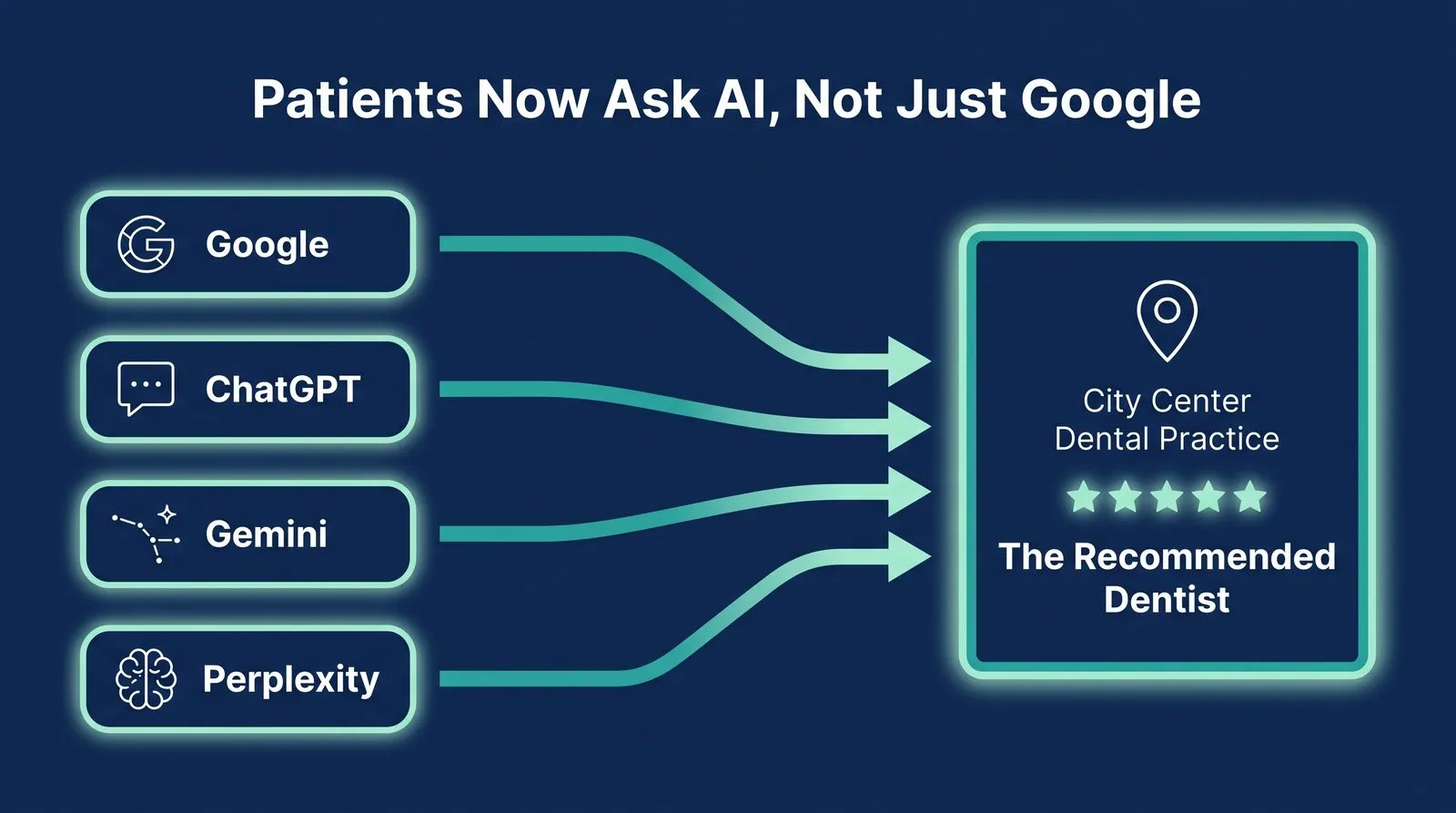
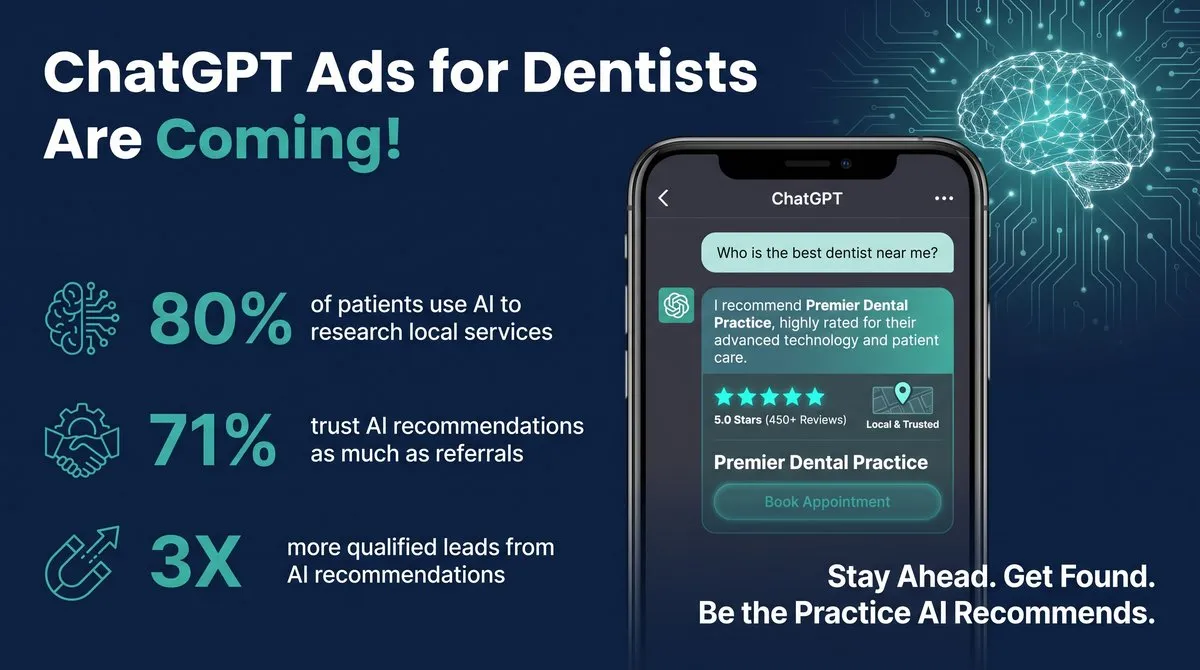
AI search is more conversational. A patient may ask, “I have a missing tooth — should I get an implant or a bridge?” , “My child is afraid of the dentist — how do I find a gentle pediatric dentist?” , or “I want a better smile, but I don’t know if I need veneers, bonding, or whitening.”
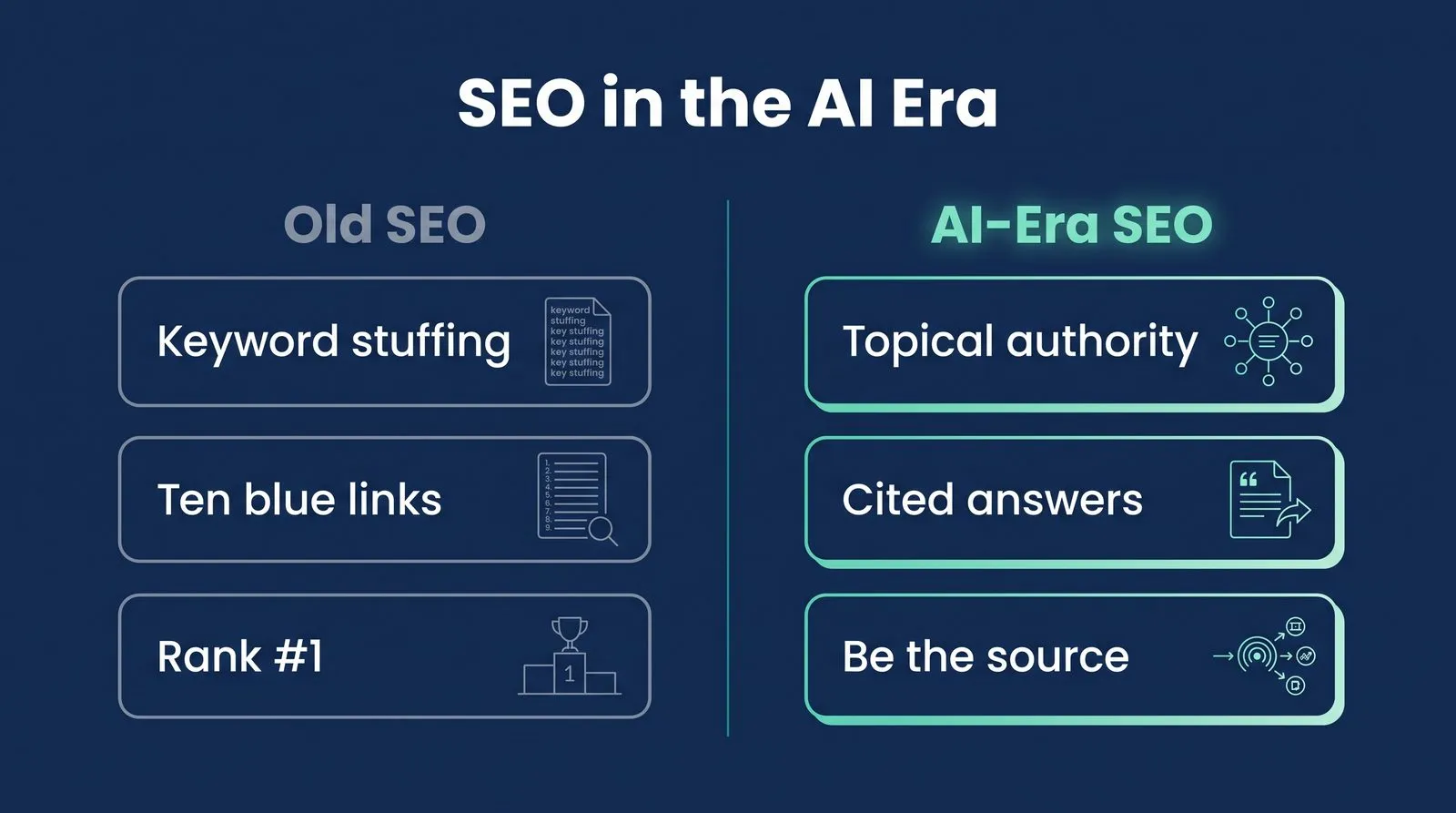
This changes dental SEO. It’s no longer enough to target short service keywords — practices need content that answers the full patient journey: the question, the concern, the comparison, the cost issue, the timeline, the fear, and the next step. The best dental SEO strategy is moving from “rank for a keyword” to “own the patient conversation.”
AI Is Changing Dental SEO
AI dental marketing starts with better SEO strategy. Google’s SEO Starter Guide explains that SEO helps search engines understand content and helps users find and explore it. For dentists, that means your website should be organized around the services patients actually search for and the questions they ask before booking. A strong dental SEO structure should include:
- A homepage focused on your location and core value proposition
- Dedicated service pages for each major treatment
- Location pages if you serve multiple areas, plus doctor bio pages
- Insurance and financing pages and emergency dental care pages
- A compliant before-and-after or smile gallery where appropriate
- FAQ sections and blog content targeting patient questions
- Internal links between related services and clear calls to action
AI can help identify the gaps — whether your dental implant page answers the questions patients ask most, how your Invisalign content compares to competing pages, which FAQs are missing, and where internal links belong. But the final strategy still needs human review. Dental content must be accurate, compliant, useful, and aligned with how your practice actually provides care.
AI Is Changing Local SEO for Dentists
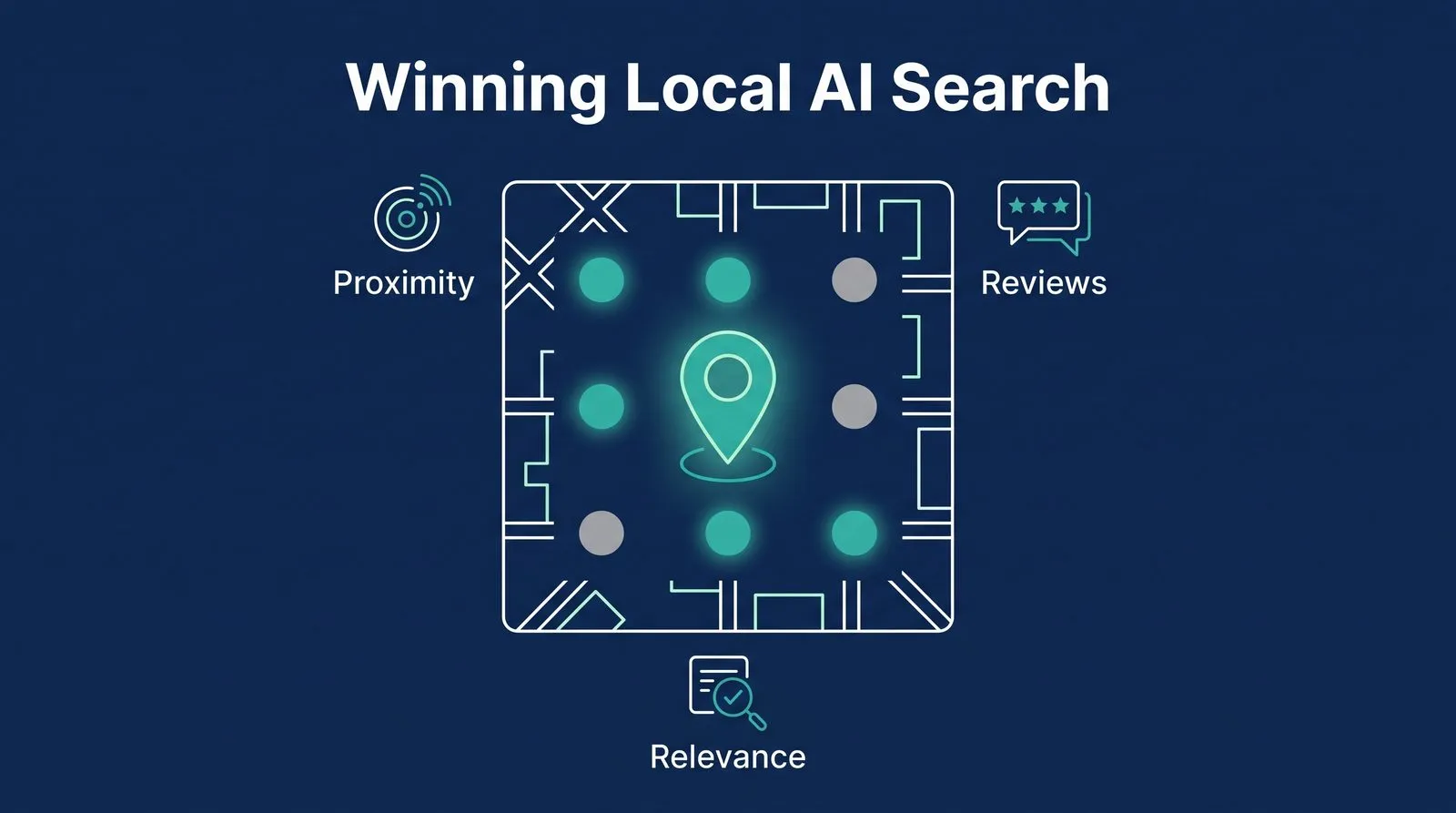
Local SEO is still one of the most important growth channels for dental practices. Google says local results are mainly based on relevance, distance, and prominence, and recommends complete business information, accurate hours, review responses, and photos. AI makes this more important, not less — because AI systems need clear, consistent, trustworthy information to work with. A strong local SEO foundation includes:
- An optimized Google Business Profile with accurate NAP
- Correct dental categories and detailed service listings
- Updated hours and appointment links
- High-quality office photos and consistent review responses
- Local backlinks and service-specific landing pages
- Clear location signals on the website
BrightLocal reports that 80% of U.S. consumers search online for local businesses weekly, 32% search daily, and 46% often or always add “near me.” For dentists, local intent is still the engine — AI just changes how that intent is discovered, analyzed, and converted.
AI Is Changing Google Ads for Dentists
AI is already built into major paid media platforms. Google says Performance Max uses Google AI to help advertisers find customers across YouTube, Display, Search, Discover, Gmail, and Maps — advertisers provide conversion goals, budget, and creative assets, and Performance Max automates bidding and targeting. For dentists, paid search is becoming less manual and more signal-driven.
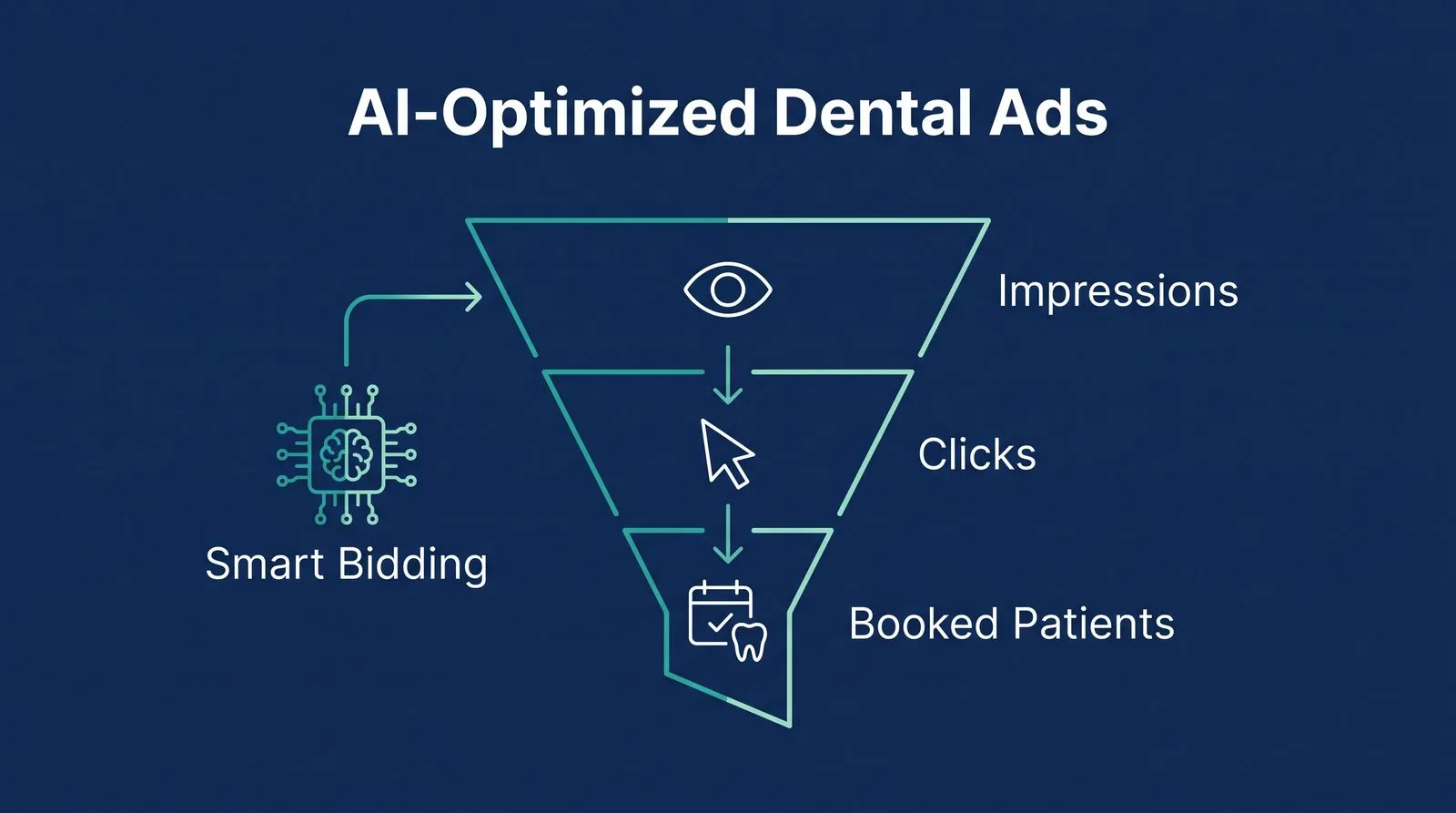
That doesn’t mean dental PPC is easier — it means the inputs matter more. AI-powered ad campaigns need:
- Clean conversion tracking and strong landing pages
- Accurate service pages and high-quality creative assets
- Clear location targeting and call tracking
- Negative keywords, exclusions, and budget controls
- Lead-quality analysis and appointment/treatment-start feedback
If your campaign is optimized only for cheap leads, AI may find cheap leads. If it’s optimized for booked consultations and treatment starts, AI has better signals to work with. That is the difference between using automation and steering automation.
AI Is Changing Dental Content Marketing
Dental content used to be written mostly for search engines. Now it needs to work for search engines, AI tools, and real patients. A good dental blog should clearly answer real questions — “How much do dental implants cost?”, “What’s the difference between veneers and bonding?”, “How long does Invisalign take?”, “What should I do if I crack a tooth?”
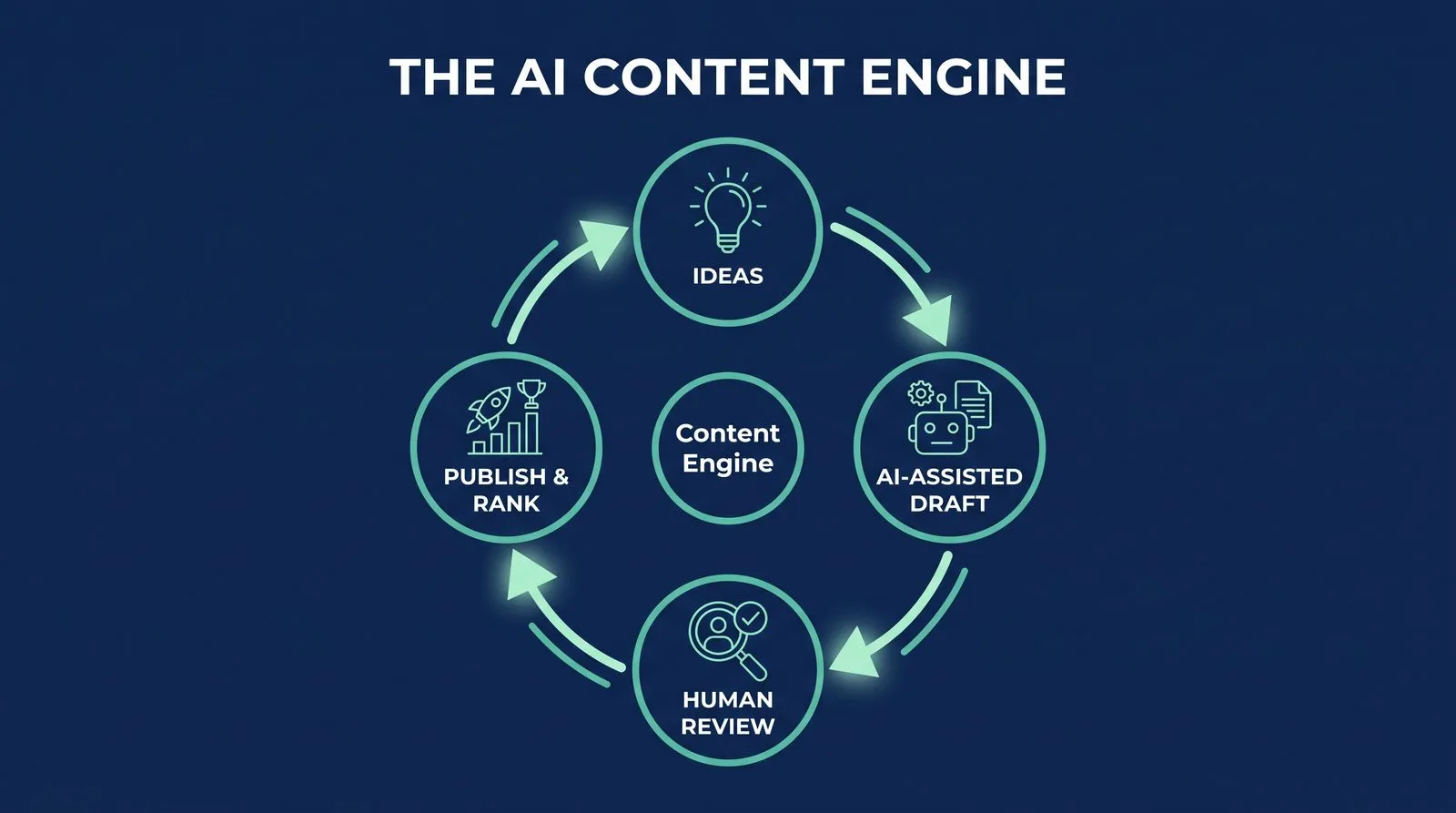
AI can help generate outlines, identify related questions, organize content clusters, and produce first drafts — but it should not publish clinical content without review.
AI Is Changing Reputation Management
Reviews are one of the most important trust signals in dental marketing. Patients want to know whether other people had a good experience — whether the team is kind, the office is clean, the dentist explains treatment clearly, and the front desk is helpful. BrightLocal’s Local Consumer Review Survey emphasizes that consumers read review details to form their own opinions.
- Identify review themes and summarize patient sentiment
- Spot recurring service issues and patterns in negative reviews
- Draft review-response templates
- Recommend service improvements
- Track review velocity by location and monitor competitor reputation
But human oversight is essential. Review responses must not reveal patient information — HHS explains that the HIPAA Privacy Rule generally requires authorization for uses or disclosures of protected health information for marketing, with limited exceptions.
AI Is Changing Dental Websites
A dental website is no longer just an online brochure — it’s a conversion system. Patients expect fast-loading pages, clear information, trust signals, easy scheduling, mobile-friendly design, and answers to their questions. AI can help by identifying weak conversion paths, missing calls to action, thin service content, duplicate pages, poor internal linking, unanswered FAQs, weak title tags, missing meta descriptions, poor image alt text, and confusing user journeys.
Google says meta descriptions can help generate search snippets when they describe a page more accurately than the page content, and recommends page-specific descriptions. Google also says alt text helps both accessibility and image understanding, and recommends useful, information-rich alt text that uses keywords appropriately without keyword stuffing.
- A clear title tag and a unique meta description
- A strong H1 and helpful H2s
- Service-specific content and local relevance
- FAQs, trust signals, and internal links
- Strong calls to action and optimized images with descriptive alt text
AI Is Changing Lead Tracking and Reporting
Many dental practices still measure marketing too lightly — clicks, impressions, calls, and form fills. That’s a start, but it’s not enough. A dental marketing system should answer better questions:
- Which campaigns produce booked appointments?
- Which calls are new patients versus existing patients?
- Which services and landing pages generate the highest-value leads and consultations?
- Which campaigns produce treatment starts and real revenue?
- Which locations are underperforming, and which keywords produce low-quality calls?
AI can help summarize call recordings, classify lead quality, flag missed opportunities, identify front-desk bottlenecks, and connect campaign performance to patient acquisition — but the data must be clean. If tracking is broken, AI will only help you make bad decisions faster. That’s why PMAX focuses on analytics, attribution, call tracking, and practical reporting, not vanity metrics.
AI Is Changing How Dental Practices Compete
The dental practices that benefit most from AI won’t necessarily be the largest — they’ll be the ones with the best systems, because AI rewards strong inputs. That means:
- Better websites and better service pages
- Better reviews and better tracking
- Better creative and better calls to action
- Better internal processes and better compliance
- Better follow-up and a better patient experience
A practice with poor reviews, weak landing pages, thin content, and broken tracking won’t magically win because it uses AI. A practice with strong fundamentals can use AI to move faster and make smarter decisions. That’s where the opportunity is.
What PMAX Dental Marketing Recommends
1. Build a dental SEO content map. Start with your highest-value services and create content clusters around dental implants, Invisalign, emergency dentistry, cosmetic dentistry, sedation, veneers, crowns, pediatric dentistry, full-arch implants, and new-patient exams. Each cluster should include a service page, FAQs, supporting blog posts, internal links, and local relevance.
2. Upgrade your Google Business Profile. Keep it accurate, active, and complete. Google says complete, accurate business information helps you show up in local search results, while review count and review score can also factor into local ranking.
3. Improve your landing pages. Every major paid campaign should send traffic to a matching landing page — implant ads to an implant page, emergency ads to an emergency page, Invisalign ads to an Invisalign page, cosmetic ads to a cosmetic page. Specific intent deserves a specific page.
4. Use AI for research, not blind publishing. Use AI to generate outlines, content ideas, keyword clusters, first drafts, and reporting insights — but don’t use it to publish clinical claims without review. Dental marketing needs speed, but it also needs accuracy, compliance, and trust.
5. Track the full patient journey. Track calls, forms, booked appointments, consultations, no-shows, treatment starts, and production when possible. The future of AI dental marketing belongs to practices that feed their systems better data.
How PMAX Dental Marketing Uses an AI Edge
PMAX Dental Marketing is built for dental practices that want growth without guesswork. Our AI-assisted approach can support:
- Dental SEO strategy and keyword clustering
- Google Ads campaign planning and competitor research
- Local SEO and Google Business Profile optimization
- Paid social campaigns and landing page strategy
- Content planning, call tracking insights, review strategy, conversion rate optimization, and reporting and attribution
The goal is not to chase every new tool — it’s to build a marketing system that helps your practice show up wherever patients are making decisions: Google, Maps, reviews, websites, paid media, and AI-powered search experiences.
FAQ: How AI Is Changing Dental Marketing
The Bottom Line
AI is changing dental marketing, but it is not replacing the fundamentals. Dental practices still need strong SEO, local visibility, Google Ads, reviews, websites, content, tracking, and patient experience. AI makes those areas faster, smarter, and more competitive.
The practices that win will use AI to better understand patient intent, create more helpful content, improve campaign performance, strengthen local SEO, analyze reviews, and track what actually becomes revenue. PMAX Dental Marketing helps dental practices grow with full-service dental marketing and an AI edge built for the future of patient acquisition.
Ready to Put an AI Edge Behind Your Practice?
Get a free, no-obligation dental marketing audit from PMAX Dental Marketing. We’ll show you exactly where AI can strengthen your SEO, ads, content, reviews, and tracking — without losing strategy, compliance, or trust.