
ChatGPT Ads for Dentists Are Coming!
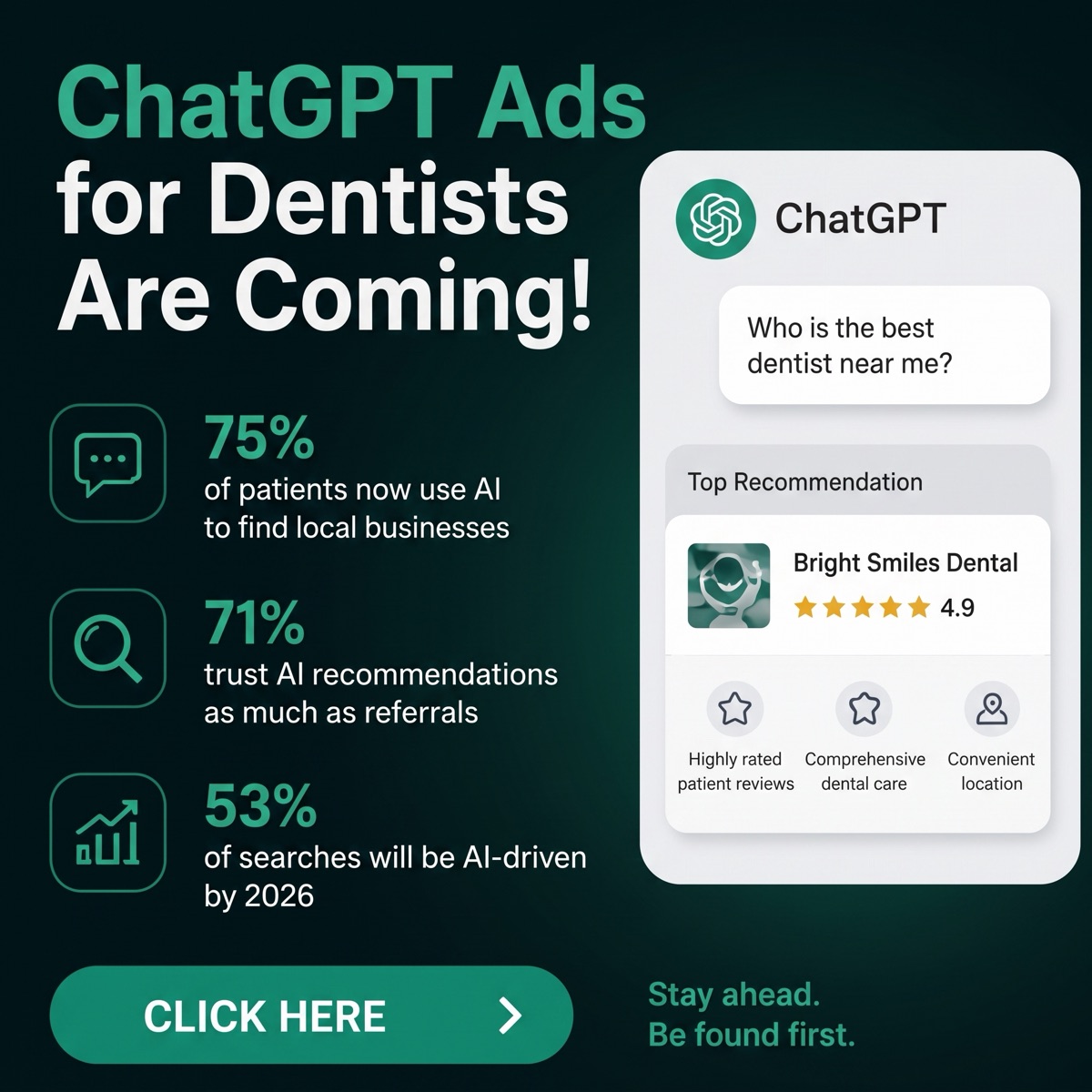
ChatGPT Ads are beginning to roll out, and dental practices should pay attention. Here’s the complete guide to OpenAI Ads Manager, healthcare advertising rules, AI search, and how to prepare for the next phase of patient acquisition.
ChatGPT Ads are no longer just a future marketing idea. OpenAI has started expanding ChatGPT advertising with a beta self-serve Ads Manager, cost-per-click bidding, and expanded measurement tools — keeping ads clearly separate from ChatGPT’s answers and without sharing conversations or personal details with advertisers.
For dental practices, this is a major signal. The way patients search for a dentist is changing.
Patients aren’t only typing “dentist near me” into Google anymore. They’re also asking AI tools real questions like “What should I know before getting dental implants?”, “How do I choose the right Invisalign dentist?”, “What causes tooth pain at night?”, and “What should I do if I crack a tooth?” These aren’t simple keywords — they’re real patient concerns.
That’s why ChatGPT ads for dentists matter. Even if direct dental advertising inside ChatGPT is restricted today, AI-powered search is already becoming part of the patient journey, and the practices that prepare now will be in a better position when AI ads, AI recommendations, and conversational search become bigger parts of dental patient acquisition. You can read OpenAI’s own announcement on new ways to buy ChatGPT ads.
1Key Takeaways for Dental Practices
ChatGPT Ads are becoming a real advertising environment. OpenAI’s Ads Manager Beta is designed to help advertisers create, launch, manage, and monitor campaigns in one place.
OpenAI’s ChatGPT Ads documentation says reporting can include impressions, clicks, spend, click-through rate, average CPC, average CPM, and conversions — and advertisers can use conversion measurement inside Ads Manager Beta.
The smartest move is to prepare your dental content, tracking, landing pages, local SEO, reviews, and AI visibility now.
2Why Dentists Should Pay Attention to ChatGPT Ads
ChatGPT has reached massive consumer scale, with OpenAI reporting more than 900 million weekly active users and more than 50 million consumer subscribers. That audience size matters because consumer behavior is moving toward AI-assisted decision-making.
In healthcare, patients already use the internet heavily before taking action. The CDC’s National Center for Health Statistics reported that 58.5% of U.S. adults used the internet to look for health or medical information during July through December 2022.
Dental demand is substantial too. The CDC reports that untreated dental disease contributes to more than $45 billion in lost U.S. productivity each year, and unplanned emergency dental care leads to an average of 34 million lost school hours annually.
For dental practices, three things are happening at the same time: patients are online, patients are researching health questions, and patients are using AI tools to learn, compare, and prepare before they contact a provider. ChatGPT Ads may become one more place where those decisions are influenced.
3The Big Catch: Dental Ads Aren’t Like Ordinary Local Service Ads
A plumber, roofer, restaurant, or home-cleaning company can test many local service ad platforms directly. Dental marketing is different.
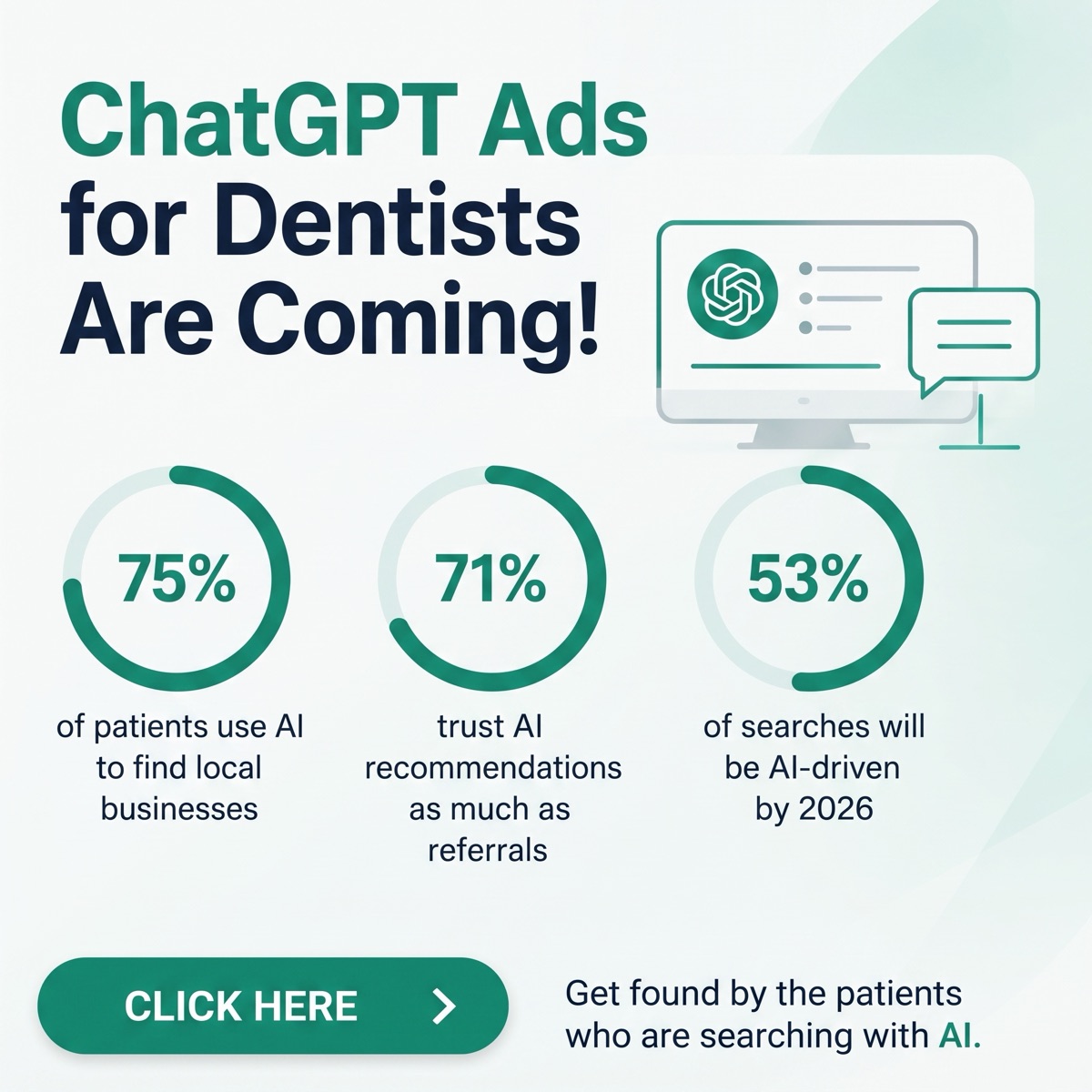
Dentists are healthcare providers, and dental advertising involves clinical services, health-related claims, patient trust, protected information, treatment expectations, testimonials, before-and-after images, and state advertising rules. OpenAI’s current ad policy says ads for regulated medical services or treatment-related claims are currently disallowed.
That doesn’t mean dental practices should ignore ChatGPT Ads — it means preparing in the right order. Instead of rushing to run “dental implant ads” inside ChatGPT, build the marketing assets that will matter when policies evolve:
- ✓AI-ready service pages and educational patient content
- ✓Compliant, conversion-focused landing pages
- ✓Strong Google Business Profile optimization
- ✓Conversion tracking and call tracking
- ✓A reputation and review-generation strategy
- ✓Clear treatment pages, FAQs, and privacy-safe marketing workflows
The first-mover advantage may not come from launching an ad tomorrow. It may come from being ready before your competitors understand what changed.
4How ChatGPT Ads Could Change Dental Patient Acquisition
Traditional dental PPC is keyword-driven. A patient searches “emergency dentist near me,” “dental implants in [city],” “Invisalign dentist near me,” or “cosmetic dentist [city]” — and your Google Ad competes for that click.
AI search is different. A patient may ask, “I’m missing a molar — should I get an implant or a bridge?”, “I’m scared of the dentist. What sedation options should I ask about?”, or “My tooth cracked — do I need a dentist today?”
That kind of interaction gives more context than a keyword. It reveals the patient’s concern, stage of awareness, urgency, objection, and likely next step. If ChatGPT Ads eventually become more open to dental-related advertisers, the best campaigns won’t simply copy Google Ads — they’ll match conversational intent. That means landing pages must be more helpful, more specific, and more trustworthy. A generic homepage won’t be enough.
5Dental SEO Comes Before ChatGPT Ads
Before dentists worry about ChatGPT Ads, they need to fix the marketing assets that AI platforms and patients already rely on. Google says local rankings are mainly based on relevance, distance, and prominence, and that complete, accurate business information helps you show up in local search.
- ✓Your Google Business Profile must be accurate
- ✓Your website must have dedicated service pages
- ✓Your reviews must be strong and recent
- ✓Your name, address, and phone number must be consistent
- ✓Your content must explain your services clearly
- ✓Your landing pages must convert visitors into calls and appointments
6What Dentists Should Do Now
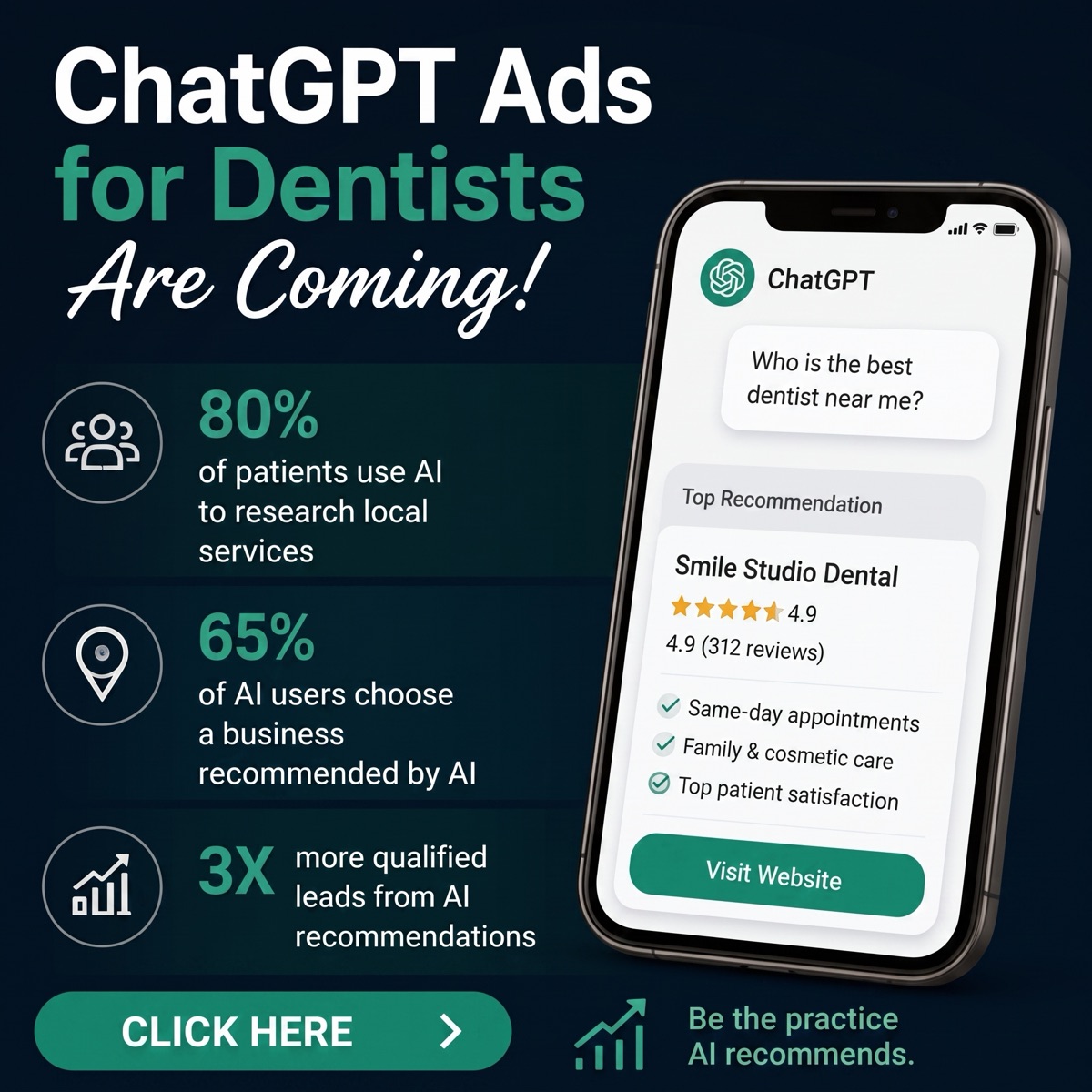
Start with the assets you control. These steps strengthen dental SEO, Google Ads, AI visibility, and conversion rates all at once.
1. Build dedicated service pages. Each major service should have its own optimized page — implants, emergency dentistry, Invisalign, cosmetic dentistry, veneers, teeth whitening, sedation, pediatric and family dentistry, crowns, full-arch implants, All-on-X, and sleep apnea dentistry. Each page should answer patient questions, explain the consultation process, include trust signals, and have a clear call to action.
2. Add patient-focused FAQs. AI search is conversational, so your content should be too — “How much do dental implants cost?”, “Are dental implants painful?”, “Is sedation dentistry safe?” Google’s SEO Starter Guide explains that SEO helps search engines understand content and helps users find and explore it.
3. Strengthen local SEO. Optimize your categories, services, photos, hours, appointment link, reviews, and Q&A. Google specifically recommends complete business information, accurate hours, review responses, and photos. BrightLocal reports that 80% of U.S. consumers search online for local businesses weekly, 32% search daily, and 46% often or always add “near me.”
4. Build compliance into your marketing. Healthcare marketing needs tighter review than ordinary advertising. HHS explains the HIPAA Privacy Rule generally requires individual authorization for uses or disclosures of PHI for marketing, with limited exceptions, and the FTC says health-related claims should be truthful, not misleading, and supported by science. Avoid uploading patient data into public AI tools, unsupported claims, guaranteed results, or unauthorized patient images and testimonials.
5. Track what actually creates patients. ChatGPT Ads reporting includes clicks, spend, CTR, average CPC, average CPM, and conversions — but dental practices need to go further. Track phone calls, form submissions, appointment requests, booked appointments, no-shows, consultations, treatment starts, and production value when possible.
7What Makes ChatGPT Ads Different From Google Ads?
Google Ads usually starts with the keyword. ChatGPT Ads may start with a conversation — and that difference matters. A search for “dental implants near me” gives you a service keyword and location intent. A conversation about implants may reveal budget concerns, fear of pain, confusion about bone grafting, uncertainty about dentures, insurance questions, and readiness to schedule a consultation.
That’s why dental practices should prepare content for the full journey, not only the final search. Strong dental marketing in the AI era combines educational content, local relevance, authority signals, review strength, service-specific landing pages, clear calls to action, privacy-safe tracking, campaign strategy, and human oversight.
8How PMAX Dental Marketing Helps Dentists Prepare
PMAX Dental Marketing helps dental practices build the foundation for the next generation of patient acquisition. Our full-service approach includes:
- ✓Dental SEO, local SEO, and Google Business Profile optimization
- ✓Google Ads, dental PPC, and paid social
- ✓Website strategy, landing page creation, and conversion rate optimization
- ✓Reputation management, review strategy, call tracking, and conversion tracking
- ✓Content planning and AI-powered campaign insights
Our AI edge helps practices move faster, identify patient-intent opportunities, build better content, improve ad testing, and understand which campaigns are actually driving growth. The goal isn’t to chase every new platform — it’s to build a marketing system that helps your practice show up wherever patients make decisions: Google, Maps, reviews, websites, paid ads, and AI-powered search.
FAQ: ChatGPT Ads for Dentists
Can dentists run ChatGPT Ads right now?
Not automatically. OpenAI’s current ad policies disallow ads for regulated medical services and treatment-related healthcare claims. Review OpenAI’s current policies before assuming you can advertise clinical services inside ChatGPT.
Are ChatGPT Ads replacing Google Ads for dentists?
No. Google Ads, Google Maps, dental SEO, local SEO, and reviews remain core dental marketing channels. ChatGPT Ads are an emerging channel to monitor and prepare for, not a replacement for proven acquisition systems.
Why should dentists care if healthcare ads are restricted?
Because patient behavior is changing. Patients use AI tools to research health questions, compare options, and prepare for appointments. Even before dental ads fully open up, practices need AI-ready content, stronger SEO, better landing pages, and privacy-safe tracking.
What should dental practices do first?
Start with the assets you control: service pages, FAQs, Google Business Profile, reviews, tracking, landing pages, and compliance review.
How can PMAX Dental Marketing help?
PMAX Dental Marketing helps dental practices grow through full-service dental marketing with an AI edge, including dental SEO, Google Ads, local search, reputation strategy, content, landing pages, and analytics.
The Bottom Line
ChatGPT Ads for dentists are coming, but dental practices need to approach this opportunity carefully. The platform is moving fast — beta self-serve tools, CPC bidding, expanded measurement, and advertising documentation — but healthcare advertising remains restricted, and dental practices should not treat AI ads like ordinary local service ads.
The right move is to prepare now: build better content, strengthen local SEO, improve reviews, track real patient outcomes, and create compliant landing pages. The practices that win won’t simply be the ones that spend the most — they’ll be the ones that show up with the right answer, in the right place, at the right moment.
Ready to Prepare for the AI Era of Dental Marketing?
Get a free, no-obligation dental marketing audit from PMAX Dental Marketing. We’ll show you exactly how to get your SEO, content, tracking, and landing pages ready for ChatGPT Ads and AI-powered patient search.